Russell Long: A Life in Politics by Michael S. Martin
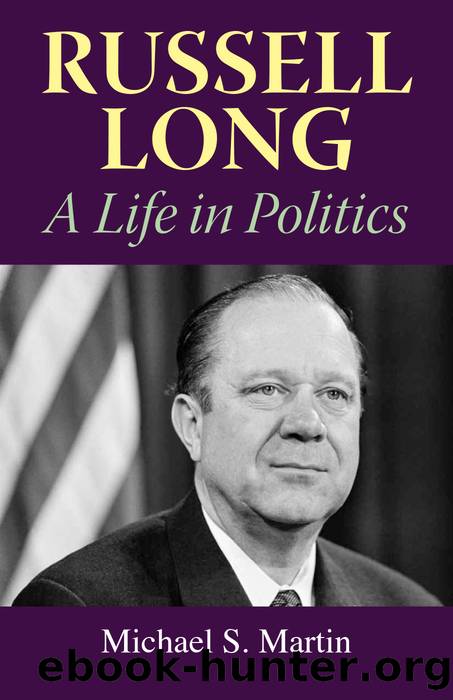
Author:Michael S. Martin [Martin, Michael S.]
Language: eng
Format: epub
Tags: Legislative Branch, American Government, United States, Biography & Autobiography, Political Science, State & Local, South (AL; AR; FL; GA; KY; LA; MS; NC; SC; TN; VA; WV), History, Political
ISBN: 9781626741119
Google: 2PcaBwAAQBAJ
Goodreads: 21891572
Publisher: Univ. Press of Mississippi
Published: 2014-05-05T00:00:00+00:00
The Coming of the Second Reconstruction
Long felt comfortable switching sides from opponent to supporter of universal health insurance for the elderly, but if he ever thought of making such a switch on civil rights, he never hinted at it publicly. Events in Louisiana saw to that. The governorâs race of 1960 had been the first statewide campaign since the 1930s in which the old Longite/Anti-Longite paradigm was overshadowed by another issue: segregation. Jimmie Davis maintained a hard line against public school integration and rode that stance to victory. Events in New Orleans soon put his campaign pledges to the test.26
It took six years for the city of New Orleans to take seriously the Supreme Courtâs Brown v. Board desegregation mandate. And had it not been for U.S. district judge J. Skelly Wright, the city leaders and school system might have dallied much longer. In early 1960, however, Wright, among the nationâs most liberal federal district judges, ordered the New Orleans school system to submit to him a plan for integration by May of that year. When the Orleans Parish School Board refused to do so, Wright created his own plan for the gradual integration of the schools, to begin in September.27
Wrightâs order put Long on the defensive. The senator suggested in a televised interview that the people of New Orleans âdonât have to open those schools at all in September,â and he stated that âwhen the people are faced with a complete salt and pepper integration . . . they are not going to go along with it. I wouldnât and I do not think the average person of New Orleans will.â To Long, the ruling was a mistake, and although he had no evidence for it, he blamed the decision on Judge Wrightâs ambition. The integration order, Long wrote, âis an irresponsible and extreme act by a man . . . attempting to dump an impossible situation on the people of Louisiana in the hope that it might help him achieve eventual promotion to the Supreme Court.â28
That June, in an effort to stave off Wrightâs integration order, Louisianaâs state legislature placed control of the New Orleans school system into the hands of Governor Davis, who ordered that the schools remain segregated. Judge Wright then declared Davisâs order unconstitutional and again ordered the schools integrated; this time the judge pushed the date back to November 14. Despite more delaying tactics on the part of the state legislature and Senator Longâs ominous warnings about the dangers of âa complete salt and pepper integration,â four black students entered two white schools on the appointed date.29
Before the actual desegregation, Long had warned New Orleanians not to engage in âunsightly demonstrations,â and he had cautioned that âbad manners and angry gestures hurt rather than help our cause.â His statements apparently fell on deaf ears, however, for on the day after the first black students attended the white schools, an audience of more than five thousand heard Citizensâ Council leader Leander Perez declare, âDonât wait for your daughter to be raped by these Congolese.
Download
This site does not store any files on its server. We only index and link to content provided by other sites. Please contact the content providers to delete copyright contents if any and email us, we'll remove relevant links or contents immediately.
The Secret History by Donna Tartt(19088)
The Social Justice Warrior Handbook by Lisa De Pasquale(12190)
Thirteen Reasons Why by Jay Asher(8910)
This Is How You Lose Her by Junot Diaz(6887)
Weapons of Math Destruction by Cathy O'Neil(6280)
Zero to One by Peter Thiel(5802)
Beartown by Fredrik Backman(5754)
The Myth of the Strong Leader by Archie Brown(5507)
The Fire Next Time by James Baldwin(5445)
How Democracies Die by Steven Levitsky & Daniel Ziblatt(5218)
Promise Me, Dad by Joe Biden(5153)
Stone's Rules by Roger Stone(5088)
A Higher Loyalty: Truth, Lies, and Leadership by James Comey(4964)
100 Deadly Skills by Clint Emerson(4925)
Rise and Kill First by Ronen Bergman(4789)
Secrecy World by Jake Bernstein(4753)
The David Icke Guide to the Global Conspiracy (and how to end it) by David Icke(4719)
The Farm by Tom Rob Smith(4511)
The Doomsday Machine by Daniel Ellsberg(4490)
